
How Fast Will I Forget a Language If I Stop Learning It?
Updated: Dec 11, 2025
And what can you do to stop your hard-earned words from fleeing your brain like tourists catching the last bus?
Imagine this: you’ve spent months—maybe even years—learning Spanish. You can hold conversations, understand Netflix without subtitles, and even dream en Español. Then life happens. Work picks up, kids need chauffeuring, or maybe Korean dramas take over your free time. Six months later, you try to say something in Spanish and suddenly... nada. Zilch. Your tongue freezes. Where did it all go?
The question, “How fast will I forget a language if I stop learning it?” hits close to home for many language learners. The short (and slightly annoying) answer? It depends. The longer—and more useful—answer follows below.
The Science of Forgetting: Welcome to the Ebbinghaus Curve
Let’s start with a bit of brainy business.
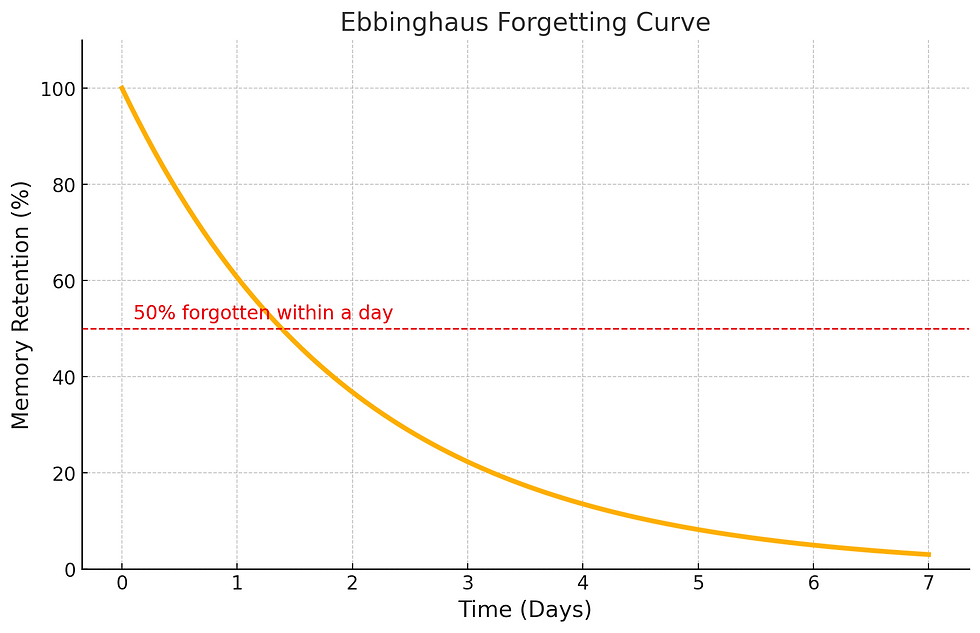
In the late 1800s, German psychologist Hermann Ebbinghaus mapped what’s now called the forgetting curve. It looks a bit like a ski slope: steep at first, then gradually leveling out. We forget new information rapidly if we don’t actively use or review it.
According to Ebbinghaus’s findings:
Within 24 hours, we can forget up to 70% of newly learned material.
After a week, that number can climb to 90%.
Now, take a deep breath before you throw your vocabulary book out the window. This curve is mostly about new information. If you’ve been learning a language for years and have used it in meaningful ways—like speaking with actual humans or reading books—the situation is a lot more hopeful.
What Affects Language Attrition?
“Language attrition” is the official term for forgetting a language. Several factors influence how fast (or slowly) this happens:
A. Level of Mastery
The better you knew the language to begin with, the more it stuck.
Beginner learners can lose significant vocabulary and grammar within a few weeks or months.
Intermediate learners retain more but might lose fluency and confidence.
Advanced or fluent speakers usually retain comprehension, but fluency might slow down.
Think of language like wet cement:
Early learners are still mixing it.
Intermediate learners have poured it, but it’s soft.
Fluent speakers? That concrete is dry—hard to crack.
B. Time Spent Not Using the Language
Unsurprisingly, the longer you go without practice, the more you forget.
But here’s the twist: forgetting doesn’t happen at a steady pace. You forget a lot at first, then much more slowly after that. That means if you don’t speak a language for a year, you’ll forget some, but you won’t lose everything—especially if you were fluent.
C. How You Learned It
Rote memorization? Toast.
But if you lived the language—via immersion, conversations, cultural exposure—your brain filed it deeper into long-term memory. That stuff doesn’t vanish easily.
D. Similarity to Your Native or Other Languages
If you're an English speaker who learned German and then stopped, you might retain more than if you’d learned Korean and taken a break.
Why? Shared roots, similar grammar, and overlapping vocabulary act like little memory anchors.
What Do People Forget First?
Language attrition doesn’t happen all at once. It’s a bit like a reverse game of Jenga—some blocks fall out quicker than others.
Here’s what typically fades fastest:
Vocabulary
Especially low-frequency words (e.g., "snail", "democracy", or "snorkel"). These are the first to go unless they’re reinforced often.
Grammar rules
Tricky verb tenses or conjugations, especially if you didn’t internalize them, start slipping.
Speaking fluency
You might know the word, but your tongue forgets how to say it quickly. Hesitation increases.
Listening skills
Understanding fast-paced native speakers becomes harder, particularly with unfamiliar accents or slang.
Interestingly, the last skills to fade tend to be:
Reading comprehension
Basic grammar structures
Core vocabulary (e.g., "eat", "go", "hello")
Your passive knowledge hangs around longer than active use. You may recognize a word but struggle to produce it.
Case Studies & Anecdotes: Real Learners, Real Forgetting
The “One-Year Hiatus” Learner
Sophie studied French for five years, got fairly fluent, and even traveled to Lyon. Then she focused on work for a year and stopped practicing. When she returned to French, she could still understand the news and read novels, but her speaking felt clunky. Her tongue had become rusty, but her brain was still sharp.
Time to recover: About 2-3 months of regular practice.
The “Beginner Drop-Off”
Jake started learning Japanese on Duolingo. He was 3 weeks in, crushing those katakana characters. Then he took a break “for a week” that turned into six months. When he returned… it was like starting from scratch.
Time to recover: Back to square one.
The “Childhood Bilingual”
Maria grew up speaking Spanish at home but shifted to English around age 10. By 30, she hadn’t actively spoken Spanish in years—but could still understand it perfectly. Speaking? A bit rusty, but it came back quickly after a few conversations with her abuela.
Time to recover: A few weeks of active use.
Can You Ever Truly Forget a Language?
Yes—but only under certain conditions.
If you were never fluent, and stop entirely, most of your knowledge can fade. However, true fluency leaves a permanent imprint on the brain.
This is especially true for:
Childhood languages
Languages learned via immersion
Languages tied to strong emotional memories
Think of it like riding a bike in a foreign country. You might wobble at first, but muscle memory kicks in. The grammar bike might have a flat tire, and your vocabulary bell might squeak, but you can still ride.
How to Slow Down the Forgetting Train 🚆
So, let’s say you have to take a break. Life is life. But that doesn’t mean you have to lose everything.
Here’s how to hit the brakes on forgetting:
1. Passive Maintenance
Watch a 10-minute YouTube video once a week.
Listen to music or podcasts in your target language.
Read short stories before going to bed.
Even passive exposure keeps your brain familiar with the rhythm, pronunciation, and structure.
2. Mini Practice Sessions
Review flashcards on Anki or another app. Try to come up with new words every now and then.
Read short news articles or Tweets. Follow people on social apps who speak and write in your target language.
Ten minutes a day can keep the “forgetting curve” flatter than a pancake.
3. Social Accountability
Text a friend in that language once a week.Or better yet: set up a “language lunch” once a month. Order food in your target language. If the waiter is confused, that’s half the fun.
4. Think in the Language
Even if you're not actively speaking, narrate your thoughts in the language while doing daily tasks. ("Estoy cocinando arroz. ¡No lo quemes esta vez!")
5. Don’t Quit—Hibernate
Even if you pause active study, leave the door open.
Instead of quitting entirely, tell yourself: I’m parking it, not abandoning it. Your brain likes that. It keeps the lights on.
And If You Forget… Don’t Panic
The beautiful thing about learning is that it leaves traces.
Neuroscientists call this savings—relearning is faster than first-time learning. If you learned a language once, you can learn it again—faster and more deeply.
That’s not just optimism. It’s science.
Even if you can’t recall a word right now, it’s probably still in there, somewhere between your memory of your first kiss and that weird childhood dream about flying to school in a toaster.
Final Thoughts: Languages Don’t Die, They Nap
So, how fast will you forget a language if you stop learning it?
Beginners may lose most of it in a few months.
Intermediate learners might get rusty but recover quickly.
Fluent speakers? You'll need a bit of WD-40, but it’ll come back smoother than you think.
The key takeaway?
“Use it or lose it” is only half the story.“ Use it just a little, and you might keep more than you think.”
Even the occasional exposure can preserve your language skills.
And remember, if all else fails... start by ordering a coffee in that language. Chances are, your brain will perk right back up.
If you are on the verge of taking a break, push a little bit more. This could be what makes the difference between forgetting 80% or 70%. Small but noticeable.
If you fear you've lost it all, we hope to have convinced you otherwise.
If you have any experience with forgetting a language, we would love to hear it. Comment below and show other learners they are not alone.
👉 Got more questions? Head over to our Q&A Section—chances are we’ve already answered it (and if not, we will!).
👉 Ready to start your language journey? Grab our free guide “How to QuickStart Your Journey to Fluency” and take your first steps today!


Comments